AI Can Build the Whole Stack. Why Does Specialization Still Matter?
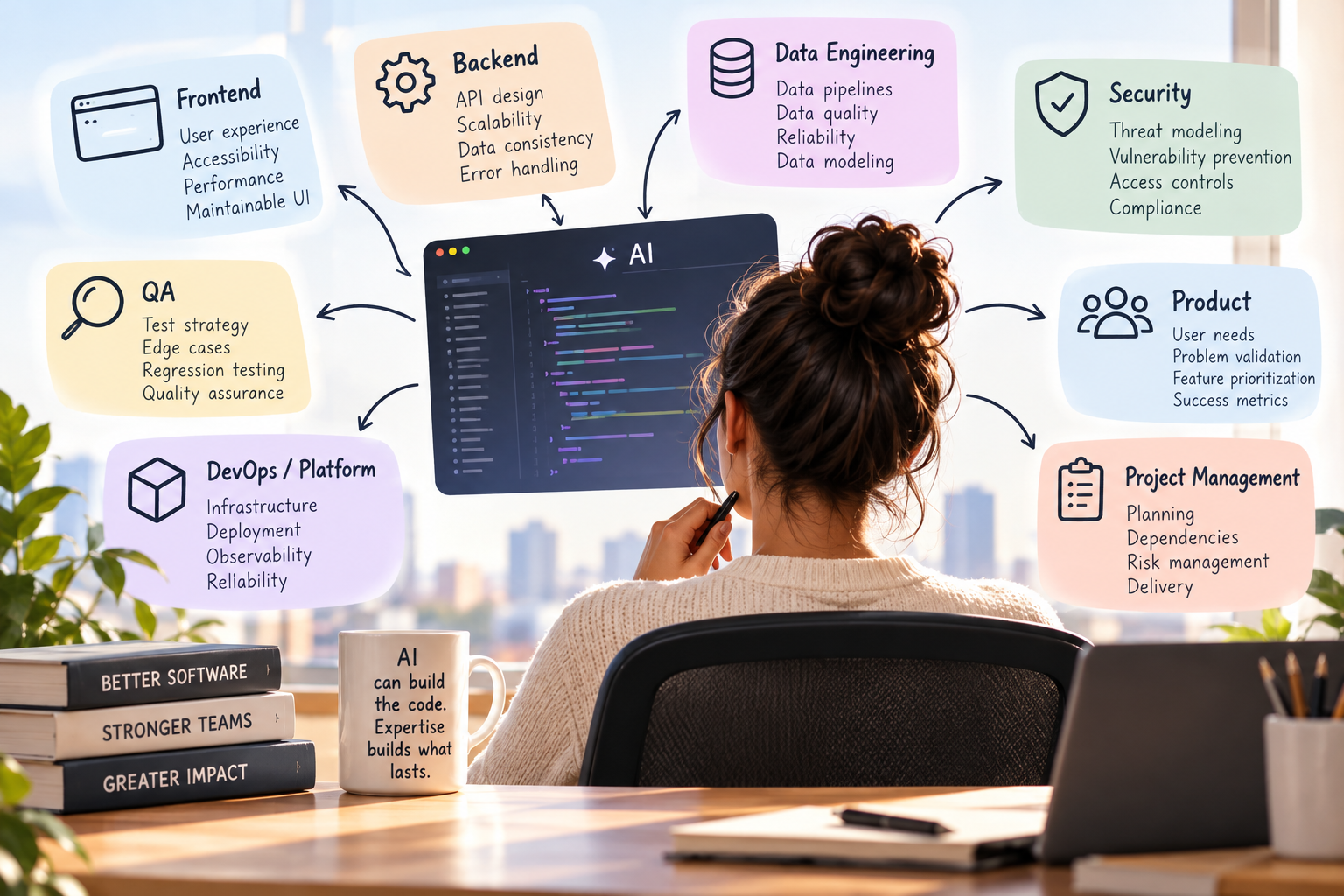
AI is changing what's possible in software development.
A single engineer can now build a frontend, implement APIs, design a database, write tests, configure infrastructure, and deploy an application with AI assistance.
Tasks that once required knowledge across several disciplines are becoming increasingly accessible.
This raises an interesting question: If AI allows us to do all these things, do we still need specialization?
I believe specialization matters just as much, even if the way we apply it is changing.
Being Able to Build Something Isn't the Same as Having Expertise
Software development involves much more than getting an application to work.
Consider the different perspectives involved in building a production-grade system:
- Frontend engineers think about accessibility, responsiveness, browser compatibility, performance, and maintainable UI architecture.
- Backend engineers consider API design, concurrency, data consistency, failure handling, and system scalability.
- QA engineers look beyond happy paths, exploring edge cases, unexpected behaviors, regressions, and risks that developers might overlook.
- Security engineers identify vulnerabilities, evaluate threats, and design safeguards before problems become incidents.
- Data engineers consider data quality, pipeline reliability, lineage, and how information moves across systems.
- DevOps and platform engineers focus on deployment safety, observability, infrastructure reliability, and operational efficiency.
- Product managers help establish what problems are worth solving, for whom, and how success will be measured.
- Project managers coordinate dependencies, timelines, risks, and communication so work moves forward effectively.
These aren't simply different sets of tasks. They're different areas of expertise, each with its own challenges, principles, and accumulated knowledge.
AI can assist with all of them. But having access to AI doesn't automatically mean having the experience to recognize every important consideration or evaluate every proposed solution.
One Engineer Can Wear Many Hats. But There Are Limits.
In startups and small teams, engineers often take on responsibilities beyond their primary specialization. AI makes this even more feasible.
And that's valuable.
But consider an engineer responsible for designing the frontend, building backend services, managing infrastructure, implementing security controls, testing the application, and coordinating delivery.
Even with excellent AI tools, that person has limited time, attention, and expertise.
They may deliver a functional application quickly, but overlook accessibility issues, insufficient test coverage, security vulnerabilities, operational risks, or data quality problems.
Not because they're a bad engineer.
But because being responsible for several disciplines doesn't make someone an expert in all of them.
This is especially important when setting expectations.
If an organization chooses to have one engineer cover the responsibilities of an entire team, it must also recognize the tradeoffs involved.
AI can reduce implementation effort, but it doesn't eliminate complexity, uncertainty, or the need for specialized judgment.
Specialization Doesn't Mean Working in Silos
None of this means every project needs a dedicated specialist for every discipline.
A small product may succeed with a few experienced engineers taking on multiple responsibilities. AI can help them move faster, learn unfamiliar technologies, and identify gaps.
But as systems grow in complexity, the value of deeper expertise becomes increasingly apparent.
Specialization also doesn't mean engineers should only work within their own domains. Understanding adjacent disciplines makes us better collaborators and helps us make more informed decisions.
The goal isn't to protect rigid job boundaries.
It's to recognize that different disciplines bring valuable perspectives that contribute to the quality and success of software.
Final Thoughts
AI is making software implementation more accessible than ever. That's an exciting development.
But we shouldn't confuse the ability to generate solutions across disciplines with having mastered those disciplines.
AI makes it easier to wear many hats. It doesn't make us experts in everything.
And as we embrace AI-driven development, that distinction matters—not just for engineers, but for the organizations setting expectations about what one person can realistically deliver.
About the author
- I'm a software engineer with over 15 years of experience. While my background is primarily in backend engineering, my work today spans cloud infrastructure, AI integrations, and the systems that support modern software applications. I started this blog to share what I’ve learned in a simplified, approachable way — and to add value for fellow developers. Though I’m an introvert, I’ve chosen to put myself out there to encourage more women to explore and thrive in tech. I believe that by sharing what we know, we learn twice as much — that’s precisely why I’m here.
Comments
Join the discussionThanks for sharing your perspective! I appreciate your approach to identifying high-risk areas and bringing in specialists when needed.
Three areas I think often get underestimated are observability, security, and scalability. It's relatively easy to build something that works, especially with AI. But making sure it's secure, designing it to scale as usage grows, and anticipating potential issues by setting up proper monitoring and alerts are things that require deeper expertise and are often left for later.
And the tricky part is that shortcomings in these areas aren't always obvious until the system is in production, or users start reporting problems.
The distinction between wearing many hats and being an expert in all of them is the one that gets lost in a lot of current hiring talk. AI makes it possible for one engineer to produce a database schema, a pipeline and a frontend in a day. It does not give that engineer the experience to know which part of the output is quietly wrong.
Your point about tradeoffs is the honest version of the argument. If a company gives one person a whole team's responsibilities, it is choosing speed and accepting more risk in the areas that person knows least. That can be a fine choice, as long as it is made on purpose.
On client work we handle it by splitting a project into clearly defined problems and asking which ones carry real risk, usually security, data and payments. Those get a specialist review even when the rest is built quickly by a generalist.
Which area do you see generalists underestimate most often?